You have fixed this before.
Maybe more than once. You identified the problem, you brought in something to address it, and for a while it looked like it worked. Then the same drag came back — not identically, not immediately, but recognizably. Same department, or same kind of decision, or same quarter of the year. And somewhere around the second or third time, you started to suspect that the thing you keep fixing is not the thing that keeps breaking.
That suspicion is correct.
The single most useful move in the Leadership by Design framework is not a diagnosis. It is a direction. You stop working on the phase where the pain shows up and start working backward from it, because in an organizational system the fracture is almost never where it hurts.
Why does the same organizational problem keep coming back after you fix it?
Because you fixed the place it was visible, and visibility and causation are not the same thing.
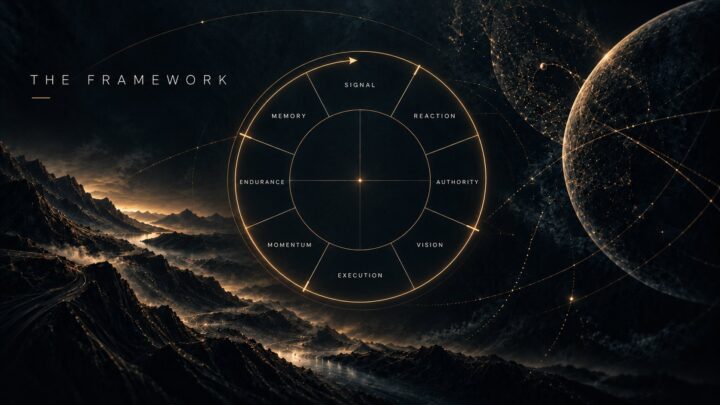
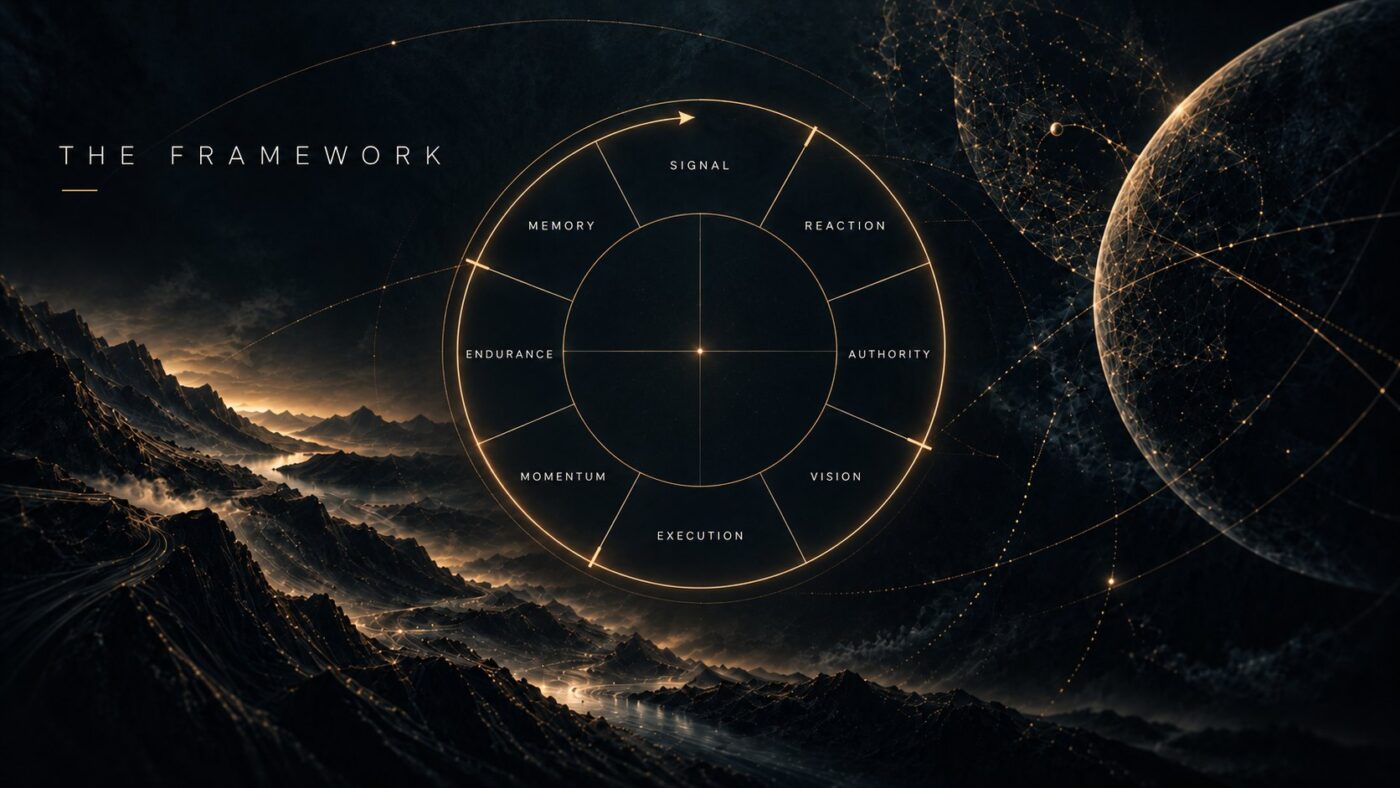
An organization is a sequence. Leadership by Design describes that sequence as eight phases — Signal, Reaction, Authority, Vision, Execution, Momentum, Endurance, Memory — and the order is not a filing convention. Each phase runs on the integrity of the one before it. Vision is built out of decisions, and decisions are made at an altitude that Authority sets. Execution runs on the direction Vision produced. Momentum accumulates on whatever Execution has been doing, correctly or not.
Which means a failure at any point in that chain does not stay put. It propagates forward, and it gets louder as it goes, and it shows up most visibly at the point where somebody finally has to account for a number.
That is the phase you can feel. It is rarely your broken phase.
An organization does not tell you where it is fractured. It tells you where it is currently paying for the fracture.
The repair you funded was not wrong about what it addressed. Communication training does improve communication. A planning offsite does produce a plan. What it could not do was hold, because whatever produced the problem was still running the entire time — and it was not necessarily one step back. It may have been three phases upstream, or four, feeding the same failure into the same place on the same schedule while you repaired the far end of it.
That distance is the reason this is hard. If the cause were always one step behind the symptom, everyone would find it. The cause is somewhere behind the symptom, and how far back is the question.
What is the diagnostic descent?
The diagnostic descent is the practice of tracing an organizational failure backward through the lifecycle, one phase at a time, until it stops moving.
That is the whole method. You take the symptom, you ask what phase it is appearing in, and then you ask whether that phase could have produced it on its own. If it could not — if the thing that phase needed to work was already broken when it arrived — you step back one phase and ask again. You keep stepping until you reach a phase where the answer is yes: this could have started here.
It is a lot less impressive than it sounds. It is also the difference between three years of expensive repairs and one that holds.
Two things make it hard to do. The first is that every phase along the way contains something wrong, so the descent is a series of opportunities to stop too early. There is always something to fix where you are standing. The second is that the further back you go, the closer you get to the leader, and there is a natural gravity in every diagnostic process that pulls it away from the person commissioning it.
What does the descent look like in practice?
Here is a composite — a pattern I have watched in several organizations, none of them named, assembled into one so the mechanism is visible.
A hundred-and-eighty person company makes something physical. The stated problem, the one in the leadership meeting, is execution: they cannot ship on time. Delivery dates slip, the slips are announced late, and the pattern has been consistent for about five quarters.
So they work on execution. New project management software. A revised stage-gate process. Two experienced operations hires. All defensible, all competently done, and for one quarter it improves.
Then it comes back.
Step back one phase. Could Execution have produced this on its own?
Execution runs on discipline — the same work, the same way, at a standard that holds under pressure. And when you look, the discipline is there. People are following the process. The stage gates are being run. What is happening is that the schedule they are executing against was never achievable, and everybody involved knew it about two weeks in.
That is not an execution failure. That is a failure that arrived at execution.
Step back. Momentum.
The schedules are set by extrapolating from the last successful quarter. Two years ago the company had an exceptional run, and that run became the baseline. Every plan since has been built off a number that was produced under conditions that no longer exist. Nobody decided to do that. It happened the way momentum always happens: the organization kept moving in the direction it was already moving, and the movement started supplying its own justification.
Could Momentum have produced this? Partly. But momentum accumulates on a direction, and somebody set the direction.
Step back. Vision.
Here it gets interesting. The direction was set at the wrong altitude. The leadership team is making commitments — to customers, to the board — using information from a height at which the constraints are invisible. From up there, the schedule looks achievable, because from up there you cannot see the two-week qualification cycle that every one of these builds requires.
That is a Vision problem, and Vision problems are where most diagnostics stop, because at this point you can write a useful recommendation. Improve information flow to the leadership team. Add operational representation to planning.
It will not hold. Ask why the altitude is wrong.
Step back. Authority.
The people who know about the qualification cycle are three levels down and they have raised the flag. Twice. Both times, the commitment had already been made externally by the time it reached the planning conversation, and the answer was a version of we will find a way.
They found a way twice. Then they stopped raising it.
Now the altitude is wrong not because information cannot travel but because the people holding the information learned that raising a flag costs something and changes nothing. That is not a communication problem. It is an authority problem: the decision rights sit at a level that does not hold the constraint, and nobody below that level has the standing to hold the commitment open long enough for the constraint to be heard.
Step back once more. Signal.
Why did they stop raising it?
Because of what happened the two times they did. Not what was said — what happened. The commitment stood. The schedule stood. The people who raised the constraint were thanked, and then the thing they warned about happened, and nobody went back to them afterward and said you were right, and here is what changes.
So the organization learned. Not from a policy, not from a memo, and not from anything anyone intended. It learned from consequence, which is the only thing an organization ever learns from. Signal is not intention. It is consequence — the founding law of the framework, and the place this descent stops.
The fracture is at Signal. It is being paid for at Execution, five phases downstream and about eighteen months later.
Does the descent always go that far back?
No, and treating five steps as the standard would be its own mistake.
Here is a shorter one. A professional services firm has a Memory problem: senior people leave and their knowledge leaves with them, and every departure costs six months of rebuilding relationships the firm thought it owned.
The obvious repair is documentation, and they run it. A knowledge management system, a mandated handover process, an exit-interview protocol. It produces documents nobody opens.
Step back one phase. Endurance.
The firm has been running at sustained high utilization for three years. It has held firm, and holding firm is not nothing — the people who did it deserve the credit. But nothing has been written down during that time because there was no hour in which to write it, and knowledge that lives in a person instead of a structure leaves when the person does.
Could Endurance have produced this on its own? Yes. Sustained pressure with no slack is a complete explanation for undocumented knowledge, and there is nothing upstream that had to break for it to happen.
The descent stops at two steps. The repair is not a knowledge management system. It is capacity — the deliberate creation of the hours in which transfer happens — which is an Endurance repair, not a Memory one.
The difference between this descent and the previous one is not that this firm is healthier. It is that the fracture sits closer to the top. How far back a descent runs tells you how long the fracture has been feeding, not how bad the organization is.
How do you tell a symptom from a source?
One question, asked at each phase: could this phase have produced this outcome if everything upstream of it had been sound?
If the answer is yes, you have found the source. If the answer is no — if the phase was working with materials that were already compromised when they arrived — you are looking at a symptom, however painful and however real.
Three tells that you are still standing in a symptom.
The people closest to it are not confused
When you ask the operators why the schedule slipped, they do not say we are not sure. They tell you immediately, with detail, and most of them have told someone before.
That is diagnostic, and it runs opposite to intuition. A true phase-level failure is confusing to the people inside it — the mechanism is broken where they are standing, and they can see the effect without seeing the cause. A downstream symptom produces the reverse: a workforce that understands the situation completely and has stopped expecting anything to come of saying so.
So the confidence of the explanation is the signal. When five people in three departments give you the same account, unprompted, in the same words, you are not looking at something they cannot figure out. You are looking at something they figured out a while ago and gave up on.
The related tell is what happens when you ask twice. Ask a second time, a week later, and watch whether the answer gets more detailed or more careful. More detailed means they think this time might be different. More careful means they have been through this before.
The fix works and then stops working
A repair aimed at the source changes the behavior of the system. A repair aimed at a symptom changes the appearance of the system, and appearance regresses.
The shape of the regression tells you how far upstream to look. A fix that holds for a month is sitting close to its cause — whatever is producing the problem is producing it continuously and at volume, and it overwhelms the repair almost immediately. A fix that holds for three or four quarters is further away, and the cause is feeding in on a slower cycle: an annual planning process, a hiring pattern, a review calendar.
Both come back. The one that comes back slowly is more dangerous, because by the time it does, the people who ran the repair have moved on and the organization has concluded that the problem is the weather.
And there is a version of this that looks like success. Sometimes the fix does not visibly regress — the metric holds. What happened is that the pressure moved. The problem is now appearing somewhere else, under a different name, owned by a different department, and nobody has connected the two because on paper the first thing was solved.
The problem has an origin story nobody can pin down
Ask when it started.
If you get four different answers and none of them is a date, the thing you are looking at accumulated rather than happened. Events have dates. Accumulations have eras — since the reorg, after that quarter, once we got past about eighty people — and an era is what a symptom looks like when its cause has been feeding it for long enough that the beginning is out of view.
The useful follow-up is asking what changed just before the era started. People are bad at dating a slow degradation and good at remembering a discrete event, so the answer to the second question is often sharper than the answer to the first. What they name will frequently be several phases upstream of where the pain is now — which is the descent handing you its own starting point.
Where does the descent stop?
At the first phase that could have produced the outcome on its own. Sometimes that is one step back. It is often three or four. It is not always Signal.
Signal is where a great many descents end, and there is a structural reason for it rather than a rhetorical one. Signal is the material every later phase is constructed from, and it is the phase most sensitive to attenuation — a small distortion there arrives downstream as a large one, because seven phases of accumulation have had their way with it.
But Signal is not the beginning of a line. The lifecycle is a circle.
Memory returns to Signal. What an organization has retained — what it remembers about how things go here, what happened the last several times, what the building has concluded from watching — comes back around and shapes what the leader reinforces next. A degradation that starts at Execution and survives long enough to become institutional memory arrives back at Signal as distortion, and the leader emitting that distorted signal is often responding accurately to a system that taught them to.
So a descent that ends at Signal is not always a descent that ends at the leader’s character. Sometimes it ends at a leader who has been trained by their own organization. That is a different repair, and mistaking one for the other is how a diagnosis becomes an accusation.
What stays true is that Signal is where the repair has to be installed, because it is upstream of everything the organization will do next — regardless of where the distortion in it originated.
The descent does not end where the pain is loudest. It ends where the explanation stops needing another explanation behind it.
What the descent does not tell you
It does not tell you what to build.
Locating a fracture is not the same as repairing it, and the framework is explicit about the difference. The descent gives you an accurate address. What goes at that address is a design problem — reinforcement architecture, decision rights, what carries consequence and what does not — and designing it takes structured work inside the organization, with the people and the authority lines.
It also will not do this for you from a page. Everything above describes the mechanism. Running it on your own organization requires something a reader cannot get from reading — an outside view of a system you are inside of — and the honest position is that you are the least reliable observer of the phase you occupy.
What you can do from here is stop paying for the wrong repair.
The next time the hauntingly familiar drag shows up — and it will, because it always does — ask one question before you fund anything. Could the phase where this hurts have produced it on its own?
If the answer is no, you have been buying aspirin for a structural condition. The good news, such as it is, is that structural conditions have structural solutions. They are just not sold where you have been shopping.
The descent is the move. What it descends through is the eight-phase lifecycle, and the four structural tensions between those phases are where organizations give under load.
The framework, in full → Eight phases, four tensions, and the diagnostic system that connects them.