Skip to content
The Framework

The map exists.
Here it is.

Every organization runs on an architecture nobody drew. It produces the outcomes you get whether or not anyone intended them, and it does not appear on any org chart.

What follows is the architecture: eight phases an organization moves through, four structural tensions that recur inside them, and the diagnostic move that connects the two.

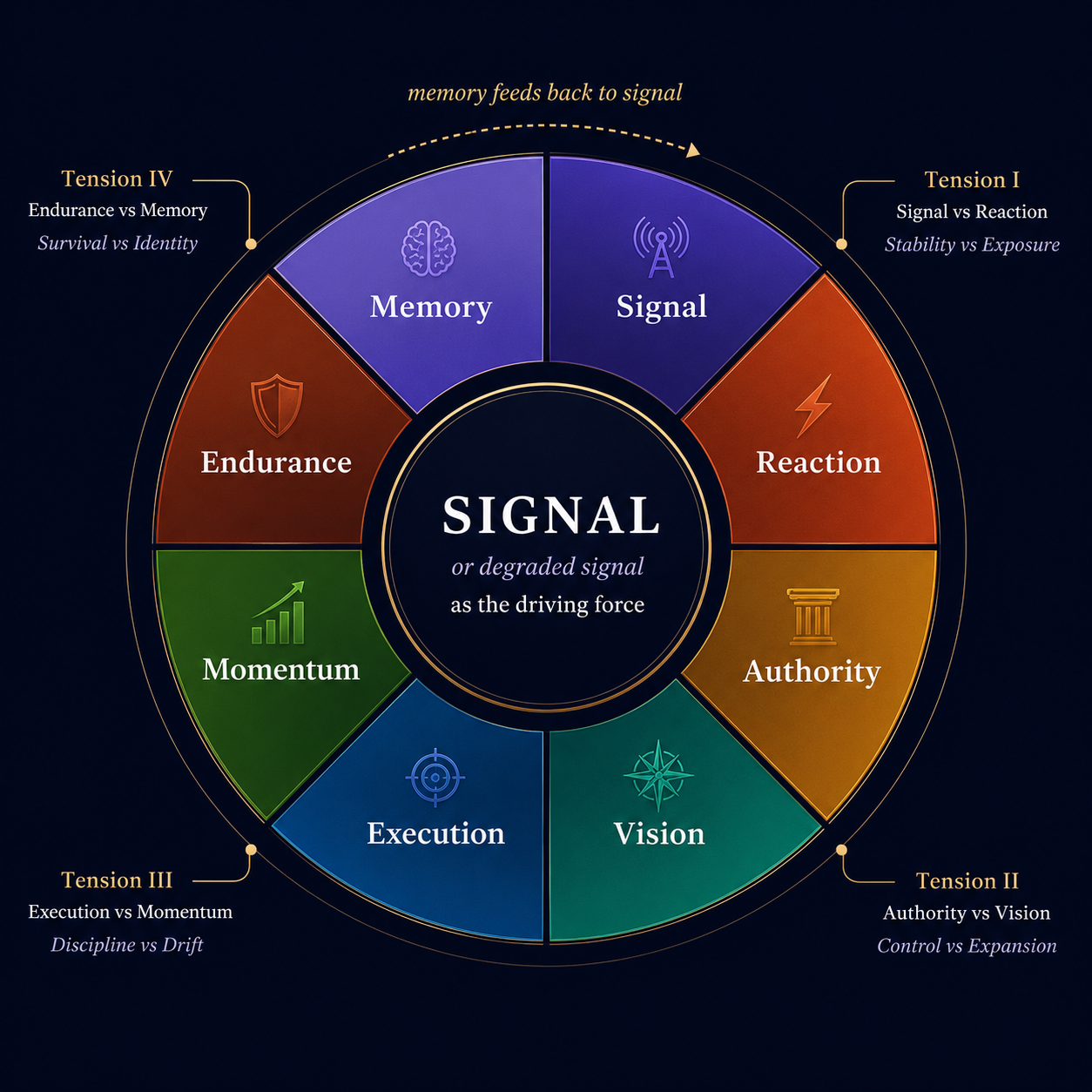
The Leadership by Design organizational lifecycle — eight phases, four tension points, and the memory-to-signal return

Eight phases. Four tension points. One diagnostic system.

The lifecycle

The organizational lifecycle. Eight phases, in order, and the order is the argument.

These are not decorative categories. They are recurring structural realities. And the order is not a convenience — each phase runs on the integrity of the one before it.

A Vision problem is almost never a Vision problem. It is an Authority problem that went unaddressed long enough to corrupt the altitude decisions are now being made from. An Endurance problem is almost never about stamina. It is an Execution or Momentum problem that has been compounding quietly under sustained pressure.

So you don’t fix the phase where it hurts. You trace the fracture back to where it started.

That’s it. That’s the whole diagnostic move, and it is a lot less impressive than it sounds.

The governing laws

Each phase has a law. Each law has a volume.

Signal The Birds and Bees of Leadership. Signal is not intention. It is consequence.
Reaction Of Rabbits and Rhinos. What fires before deliberate leadership gets a vote governs what the organization receives.
Authority The Weight of the Throne. Authority must be continuously legitimized and stabilized.
Vision What the Ground Cannot See. Strategic altitude determines clarity and timing.
Execution Nothing Remarkable. Disciplined distributed effort compounds into lift.
Momentum When the Stampede Becomes the Strategy. Momentum and conformity shape collective survival under uncertainty.
Endurance The Long Season. Coordinated rotation sustains survival in hostile environments.
Memory What the Matriarch Remembers. Institutional memory preserves identity across time.

Eight phases, eight volumes. The Birds and Bees of Leadership, which establishes the governing law of Signal, is available now. The remaining volumes are in development.

Where it breaks

The failure isn’t in the phase. It is in the tension between two of them.

Four structural tensions recur across every organization. They are not personality conflicts and they are not communication failures. They are the predictable places an architecture gives way under load.

Read the four below. One of them is going to sound like a Tuesday you have had.

Signal vs. Reaction — Stability vs. Exposure
Tension I

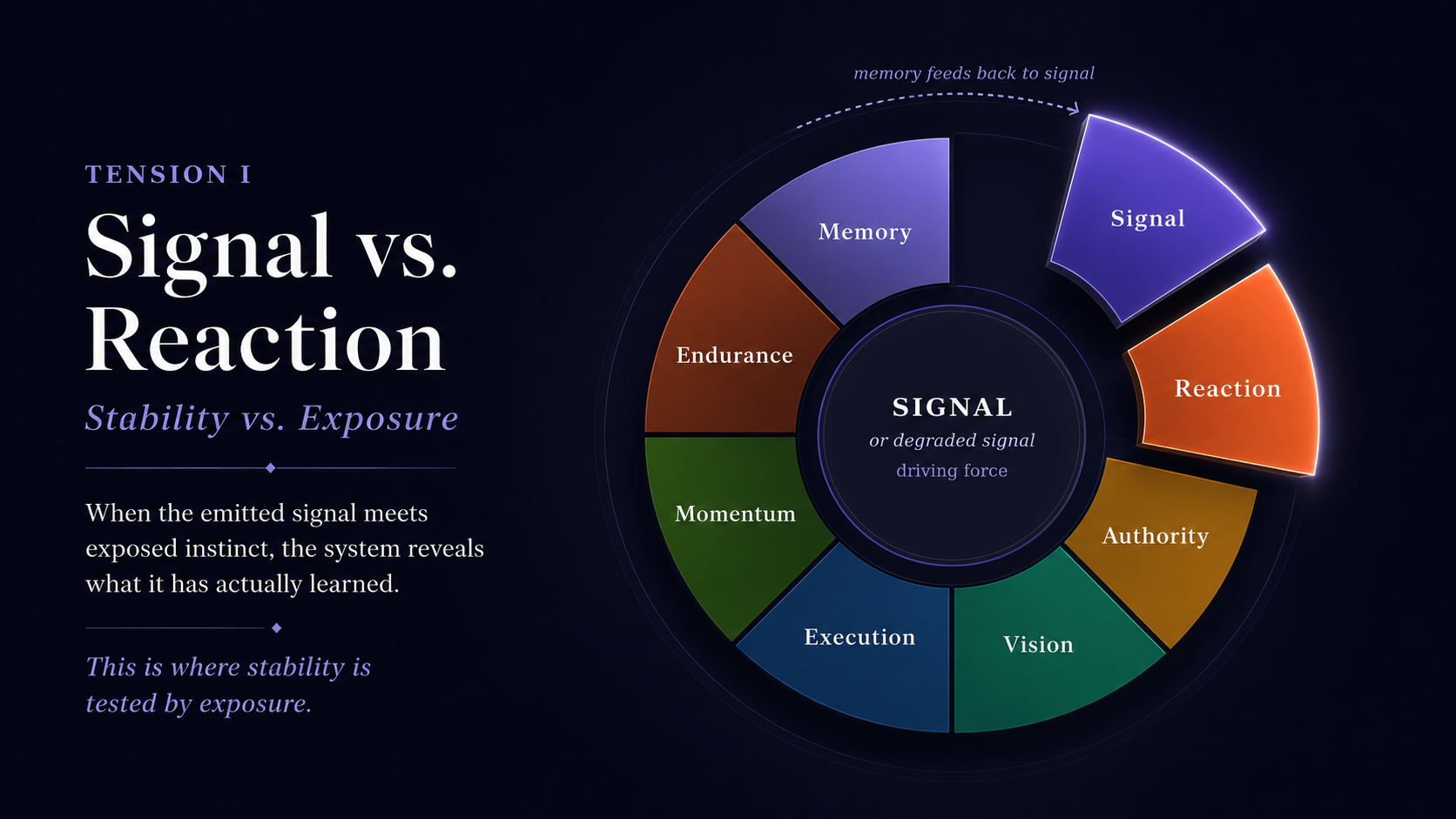
Signal vs. Reaction Stability vs. Exposure

The COO of a mid-sized manufacturer has a habit he has never examined. When a meeting turns tense, he stops talking and starts writing. He believes he is listening carefully, and he is — but that isn’t clear to anyone else in the room. They believe he is building a file, and it isn’t unreasonable to wonder, because nothing in the organization defines what his silence means, so everyone decides for themselves.

Within two quarters, the weekly operations review has quietly changed shape. Problems still arrive, but they arrive with the solution already settled — worked out by two people in a hallway, never run past the third who would have caught the flaw in it. The numbers still reconcile, and they reconcile in a way that holds the headline steady while the leading indicator underneath it turns over. The reports are still clean, and they have gotten cheerful, which is a different thing than candid. He is getting the best-looking operations review of his career and running a plant that is performing worse than it has in years.

Nobody lied to him. Nobody decided to hide anything. They read the pen, then they acted on the read, and every one of those actions taught the next person what the room expects. He is told he is hard to read, and he accepts it as a fact about his personality. It was never about his personality. It was about the absence of anything to check the read against.

The tension: when pressure exposes what a leader does automatically, does the signal hold — or does the reaction become the new instruction?
Authority vs. Vision — Control vs. Expansion
Tension II

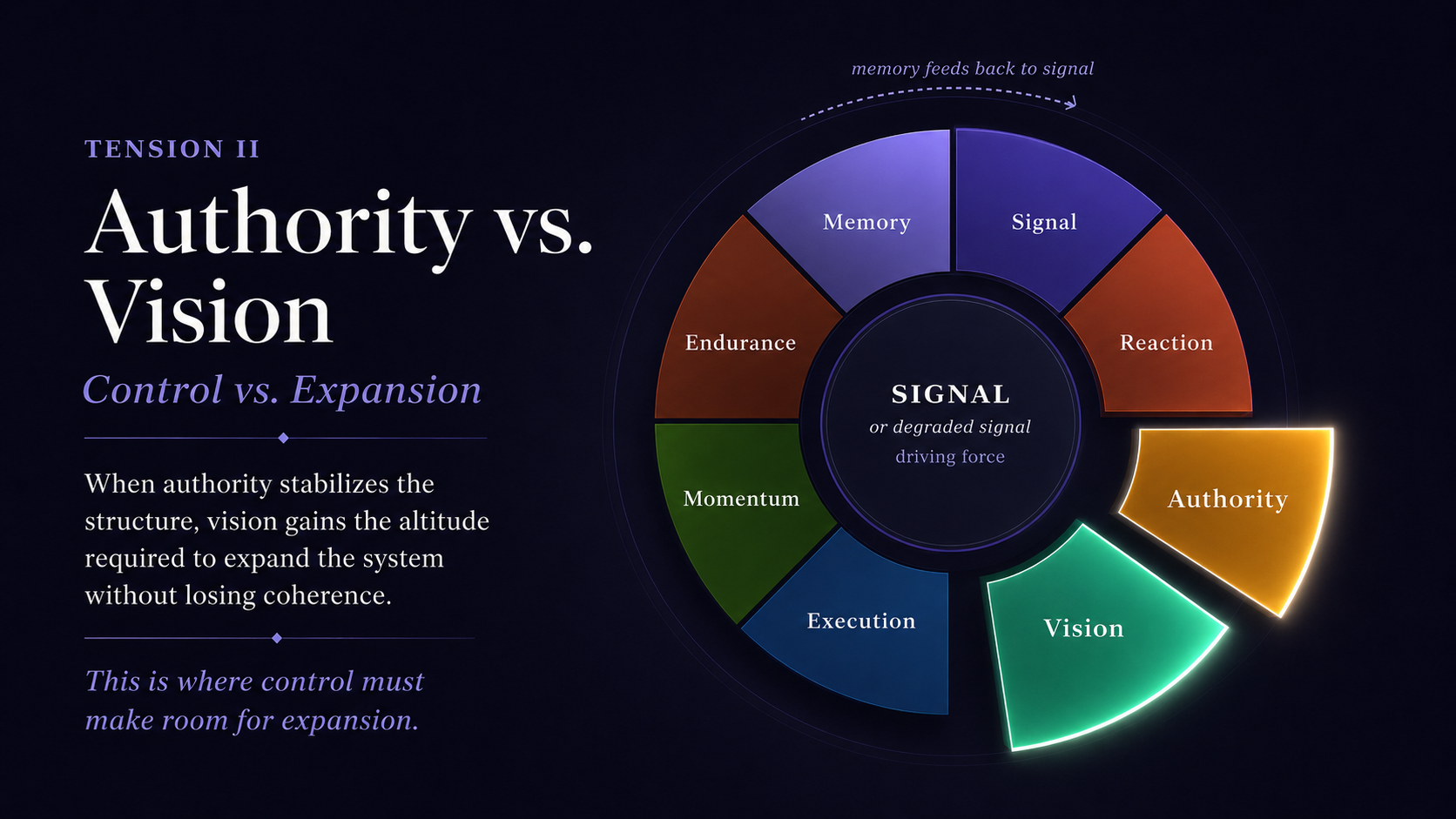
Authority vs. Vision Control vs. Expansion

A specialty construction firm has grown to two hundred people. The founder hires four regional managers for the reason every founder hires them: he cannot be in four states at once, and the company needs leaders making calls he will never see. He also reviews every bid above a threshold, which is how the firm survived its first decade. Twice, after a bid goes badly, he lowers the threshold. Both decisions are defensible. Neither is announced.

Eighteen months later the regional managers route everything upward, and the founder is working later than he did at forty people. He tells his board he has an ownership problem. His managers tell each other they were hired to run regions they have never been allowed to run. He commissions a leadership development program, because that is what you do when your leaders won’t lead. It will not work, and the money will burn, because nothing is missing. Capability that has been suppressed and capability that was never there look identical from the founder’s chair. They take opposite repairs.

The tension: can authority expand what the organization is able to decide — or does it keep pulling decisions back toward the center that built it?

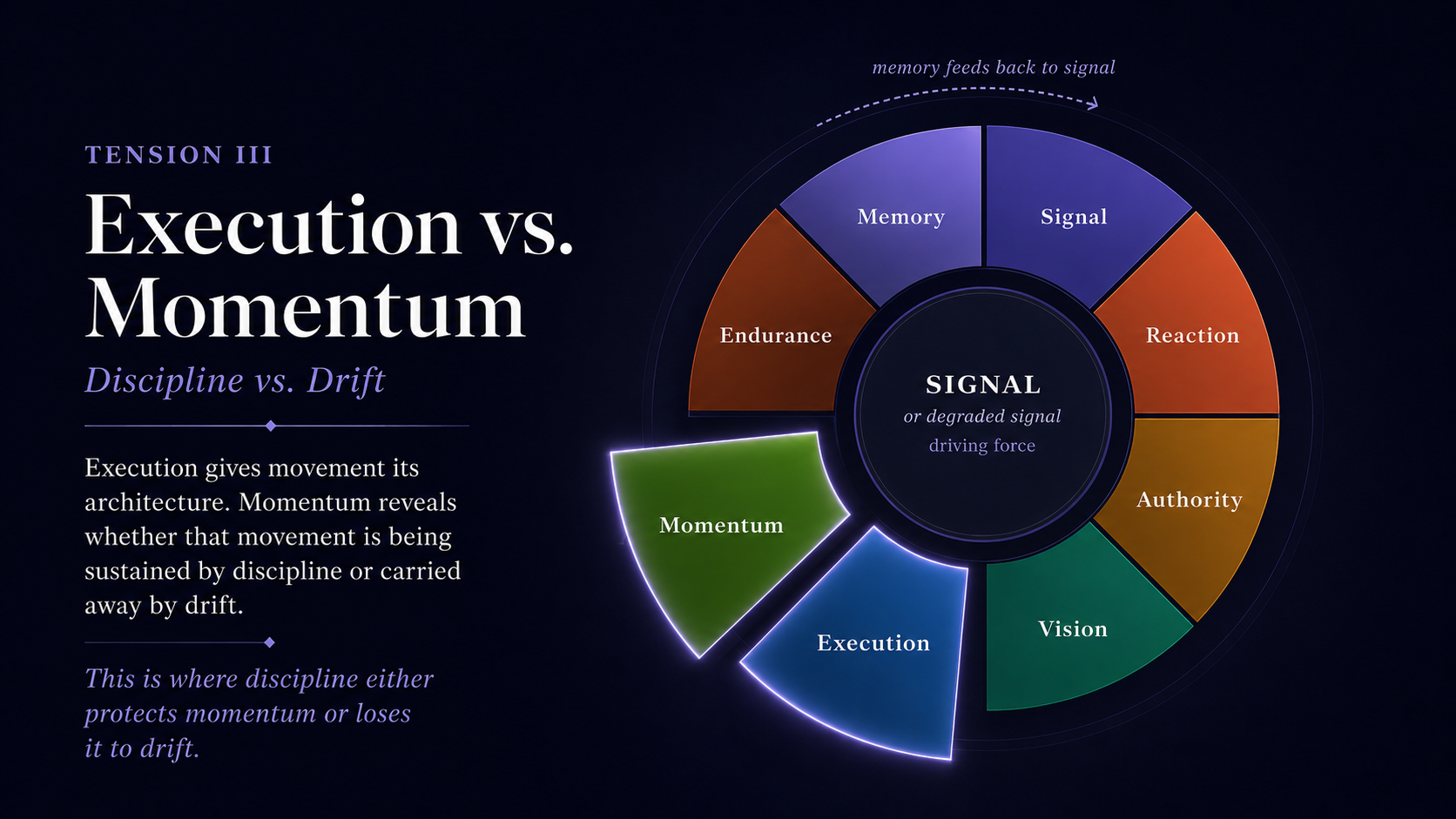
Execution vs. Momentum — Discipline vs. Drift
Tension III

Execution vs. Momentum Discipline vs. Drift

A restaurant group has an opening playbook with forty checkpoints, built the hard way across the first four locations. Location five opens strong. At location six the team skips three checkpoints, because they have done this before and they are ahead of schedule, and location six opens strong too. At location nine they skip eleven. Every skip is justified by the location that opened fine without them, and the group is now opening faster than any competitor in the market, which everyone inside reads as the system working.

Location twelve opens badly. The company investigates location twelve — the general manager, the market, the buildout, the hiring. It will find something there, because there is always something there. What it will not find is the decision that caused it, which was made at location six by people who were right at the time. Momentum is not progress. You can execute badly at full speed, and from inside the vehicle it feels the same as winning.

The tension: does discipline still govern execution as momentum builds — or has momentum started rewriting what discipline means?

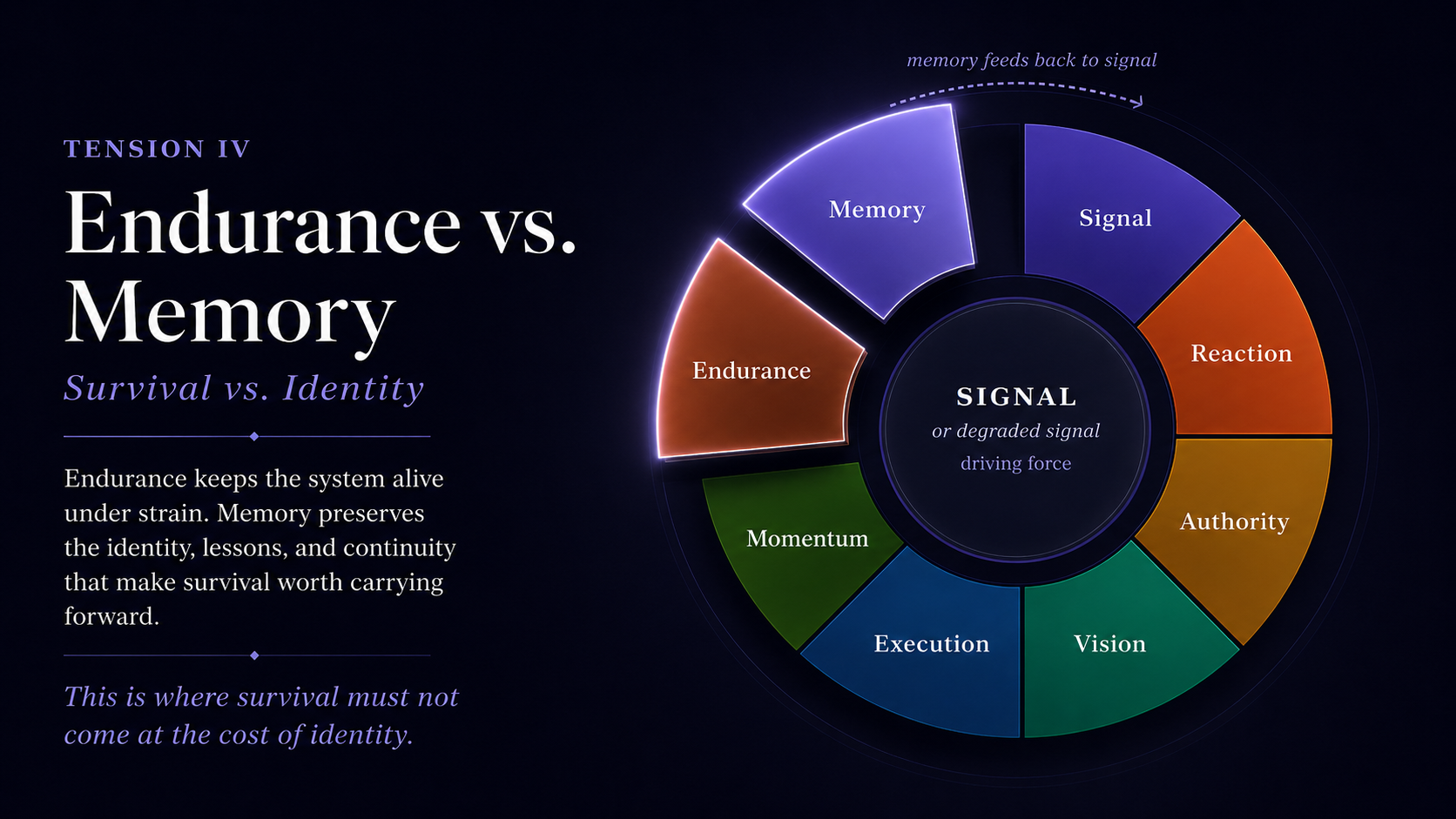
Endurance vs. Memory — Survival vs. Identity
Tension IV

Endurance vs. Memory Survival vs. Identity

A university research administration office spends four years absorbing blow after blow in order to survive: a hiring freeze, a system migration, two waves of retirements, and grant deadlines that do not move for any of it. The office hangs on. That is not a small thing, and the people who did it deserve the credit.

But somewhere in year two the pre-award checklist stopped being a document anybody read and became something you asked Denise about, and in year three Denise retired. Nobody removed step seven. Nobody could explain it either, so it stayed, the way things stay. In year five a capable new administrator reviews the checklist, finds step seven redundant, and removes it. The audit finding arrives fourteen months later.

The office did not forget through carelessness. It survived, at the speed survival required, and knowledge that lived in a person instead of a structure left when the person did.

The tension: can the organization take the pressure in front of it without quietly spending the memory that tells it who it is?

Where you sit

I can’t place your organization from here. Neither can a quiz.

Locating where your architecture is fracturing takes structured observation inside your organization. Anyone who tells you a five-minute instrument found your organizational fracture is selling you the feeling of a diagnosis, and you have probably bought one of those before.

There is one thing you can read right now, and it happens to be the one upstream of everything on this page. Phase one is Signal, and the source of the signal is a person. Before any of this becomes architecture, it is a response that fires before you have decided anything.

Under five minutes. It reads your wiring — not your organization’s.

If you already recognized your organization somewhere above, the next step is not more reading.

Or start with the book, or look at the seminar curriculum. Different depths, same framework. The one you pick is a question of how far into it you want to go.