Your Organization Is Not Listening to You. It Is Watching You.
You have been treating leadership as a communication problem. Your organization has been treating you as a research subject, and it has better data than you do.
Organizations are behavioral systems. They learn from what leaders consistently make true, not from what leaders intend — and most of the drag a leader is carrying comes from the gap between those two things.
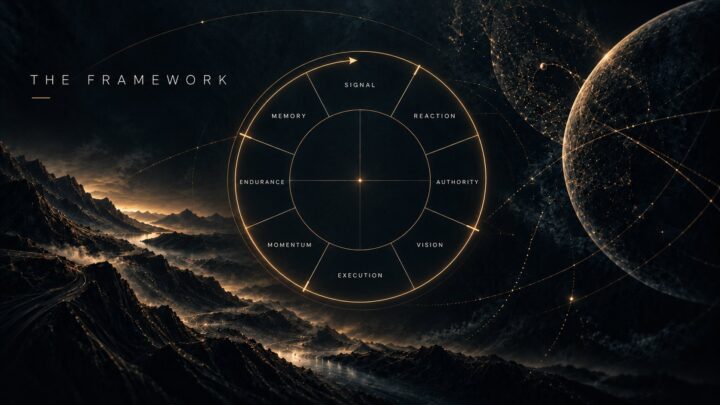
What follows works that gap. Some of it walks the eight phases in order. Some of it goes at one mechanism and stays there. Some of it argues with the framework on purpose. None of it is a list of tips.
The architecture as a whole — the eight-phase arc, the diagnostic move that connects it, and why the fracture is almost never where it hurts.
You have been treating leadership as a communication problem. Your organization has been treating you as a research subject, and it has better data than you do.
The problem you can see and feel is almost never the root problem causing the pain. Here is the move that finds its hiding spot.
One phase at a time. The mechanism each one owns, the governing law that runs it, and what it looks like when it gives.

You went quiet because you were thinking. They watched you go quiet and assigned meaning themselves, and that version is the one running your building.

You knew better and did the other thing anyway. That isn't a character flaw — it's two systems in your head that were never built to agree, and one of…

You climbed out of the detail because you could not lead from inside it, and the view up here has been worth what it cost. What nobody priced for you…
Where two phases meet under load. Four structural points, and the same four regardless of industry or size.

Your managers route everything to you. Before you spend money teaching them to lead, find out whether they never could — or whether you taught them not to.

Every corner you've cut came out fine. That isn't luck and it isn't a warning nobody heeded — it's evidence, and may very well be the reason the next one…
Starts where you are. The pattern you can describe but not name, traced back to the architecture producing it.

They told you it wasn't about the money. They were being honest — they just had no word for the real reason, so they gave you the nearest one.
Your last culture initiative worked for about six weeks, and then it quietly stopped being mentioned. Everyone saw that coming, and they were not being cynical.
Fewer problems are reaching you. That is either delegation working or information dying on the way up, and from your chair the two look identical.
The strongest arguments against the framework, taken seriously. If a claim does not hold under load, it should not be in the framework.

Everything here says your problem is architecture, not people. So what about the well-built organization run by somebody who shouldn't be running it? That's where this framework stops, and you…
Honeybees, rabbits, a rhinoceros. You have seen this on a shelf before and you are right to be suspicious — so here is what to check before you decide.
Everything above describes the mechanism. The one thing you can read about your own situation in under five minutes is what fires in you before you have consciously decided anything — which is upstream of all of it.